Jordan Lake. On my way over to do my nest monitoring of Big Pine and also the H&G nest for today, I paused for a minute. I made a little video so that all of us could just simply enjoy the light of the morning. Please hold Big Pine in your thoughts and prayers and please continue doing as much contacting as possible of those who can help close the shelter gate. Take care, be safe. Stay warm!
B. Everett Jordan Lake
TagBig Pine Nest Update
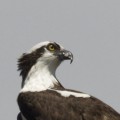
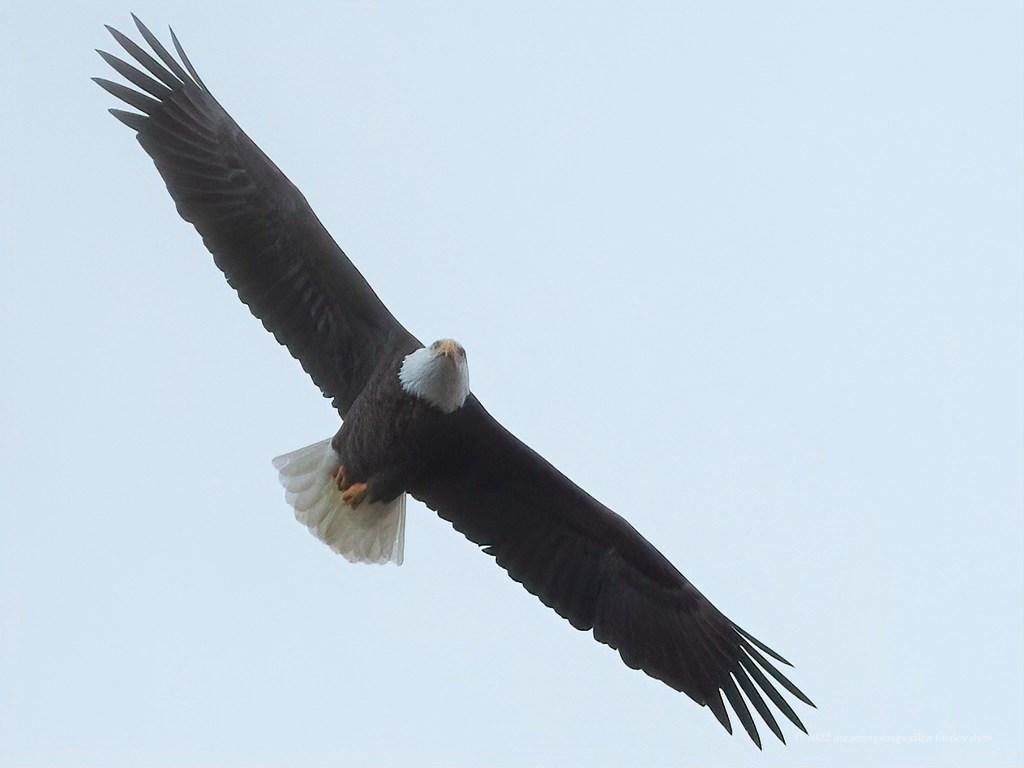
I began to realize as this past week went on, that there were no Nest Lining Materials that were trying to be brought to the nest by Mom Loblolly and Dad Pitch. This is critical because it was telling me that I needed to double check my possible egg laying dates. The nest lining materials are the last materials that go into the nest before Mom Loblolly lays her precious eggs. I was seeing lots of repair sticks trying to get to the nest (and often diverted by human intrusion) but no talons full of clutches of soft grasses. These grass materials, usually scooped from shorelines where the waves have stacked up these soft stems, are used to line the inside of the nest. This lining is then wallowed out and arranged by beak by Mom to make a protective nest bowl for the eggs and for the comfort of the incubating parent. So, over the last day or so, in consultation with the observations of others and their thoughts, the possible egg-laying date has been modified to February 1. Now, that gives us a little extra time to work on getting the gate closed so these parents are no longer harassed. It is always interesting when working with a new nest of only one prior breeding cycle because the parameters are just not really known until you have a couple of breeding seasons to use for data sources – that’s why field notes exist! So breathe a little tiny bit easier with me and let’s continue the CAMPAIGNING to get the gate CLOSED. There is now ADDITIONAL CONTACT information for you to use … it is available on the post for January 8 and the link to the same list with active hyperlinks is at my blog site https://docellensjourney.com/2022/01/08/help-big-pine-bald-eagle-nest-a-dozen-contacts/(opens in a new tab)! 1st photo is Mom Loblolly, 2nd photo is Dad Pitch this morning circling over their nest.
Big Pine Nest Update
Jordan Lake: I want to share with you a chart that is used by the US Fish and Wildlife Service to help people understand how human impacts can effect breeding bald eagles. The Big Pine nest is currently going from Phase I to Phase II. Please take a moment and study this chart and then let your mind dwell on the fact that the gate to the shelter is open and allowing human disruption. The parents are trying to lay eggs at a point in the chart where the US FWS says that “human activity of even limited duration may cause nest desertion and abandonment of territory for the breeding season”. Please, continue to let your voices be heard daily. Call, email or visit those who are refusing to shut the gate. We want the Big Pine couple to succeed in having a family while we can work on the possibility of a web cam that we can all watch.

Update Big Pine Bald Eagle Nest
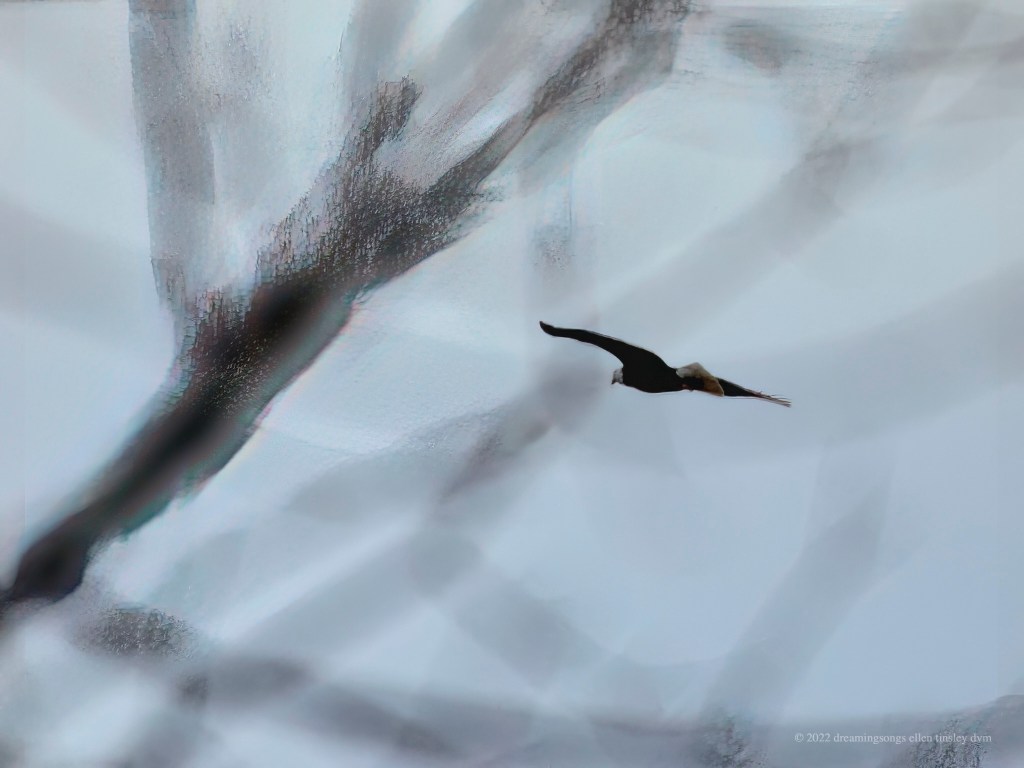
Big Pine Nest update: The gate is STILL OPEN. In the photo, that is Dad bald eagle once again trying to get a repair stick to his nest and once again having to bolt from the area. Yesterday morning there was a woman, holding a camera, standing inside the shelter building looking at the nest. She was INSIDE the single rope, single saw-horse “barrier” that is supposed to stop people from being exactly where she was. The fact that the woman was inside the “barrier” was through the utter failure of the inadequate planning of those tasked with protecting the bald eagles. Remember that this inadequate “barrier” was approved by the NC Division of State Parks, the Superintendent of the Jordan Lake State Recreation Area and the US Fish and Wildlife Service. The only way to protect Big Pine Nest is to CLOSE THE GATE to this area. Please, continue to spread the news about this problem. Please, every chance you get, contact every person who has the fate of the Big Pine Nest in their hands – contact list at the end of this post. BTW, the fact that the woman was inside the “barrier” was there is not a failure on the part of the Rangers at the park. The Rangers’ duties, first and foremost, and rightly so, are to take care of the human visitors to the park and that is a full-time task. My heart is so very grateful to all of you who are pitching in through every way each of you can. Thank you from the parent Bald Eagles of the Big Pine Nest.
Who to Contact:
Superintendent Shederick Mole
919-362-0586 ext.231
email shederick.mole@ncparks.gov
Kathy Capps
Deputy Director of Operations
North Carolina Division of Parks and Recreation
Kathy.Capps@ncparks.gov
Office 919.707.9339

John Hammond, US Fish and Wildlife Service
(the US FWS has the legal jurisdiction over this matter)
(919) 856-4520
john_hammond@fws.gov
Bald Eagle Big Pine Nest Needs Your Help!
Human Intrusion Update: The bald eagles need your help! The human intrusion continues on a daily basis and the parents are trying hard to avoid humans and still get ready for egg laying. The nest is at one of the shelters within the Jordan Lake State Recreation Area (JL SRA). I have asked superintendent Mole of JL SRA to close the gate that controls access to this area. He has said no because he says he does not want to keep anyone from entry to any areas of the JL SRA. A barrier has been constructed which consists of a single sawhorse and a row of traffic cones to stop humans from getting too close to the Big Pine Nest. The barrier is approximately 150 feet from the nest … nowhere near the distance from the nest that is required by law. My solution to Superintendent Mole as well as the NC Division of State Parks and the US Fish and Wildlife Service (US FWS) is to close the gate to shelter 8 and open its sister shelter 2 in the same area. The Superintendent and the NC Division of State Parks and the US FWS have all said NO. This is not right and is not following the laws within the Bald Eagle Act of 2007, see regulations at my blog https://docellensjourney.com/2022/01/04/bald-eagle-federal-laws/ I am asking that each of you email and or call the entities involved and let them know how you feel. The contact information is below. PLEASE tell the ones who have the lives of these bald eagles and their possible family in their hands how you feel about this. Also, please know that Pine Tree Nest has a very real possibility of being used for a Web Cam … but the eagles need their isolation in order to have a family for us to watch. I have mentioned this to all the parties involved, but I have not received a response regarding this wonderful teaching opportunity.
Remember the 660ft if you should find yourself near a nest. Please share this posting.My thanks to you from the parent Bald Eagles at Big Pine Nest!
Who to Contact:
Superintendent Shederick Mole919-362-0586 ext.231email shederick.mole@ncparks.gov
Kathy CappsDeputy Director of OperationsNorth Carolina Division of Parks and RecreationKathy.Capps@ncparks.govOffice 919.707.9339
John Hammond, US Fish and Wildlife Service(the US FWS has the legal jurisdiction over this matter)(919) 856-4520john_hammond@fws.gov
US Army Corps of Engineers actually has no say in this problem as it is occurring within the Jordan Lake State Park Recreation Area. So there no need to contact them.
Bald Eagle Federal Laws
I have copied here the two sections of the Federal Register, Bald Eagle Act, administered by the US Fish and Wildlife Service, that cover the problem of interference at a Bald Eagle nest. Please use the information below to guide you in your decisions about how to approach any intrusion problem at a Bald Eagle nest.
Bald and Golden Eagle Protection Act, current as of May 2020
“The bald eagle is protected by the Bald and Golden Eagle Protection Act even though it has been delisted under the Endangered Species Act. This law, originally passed in 1940, provides for the protection of the bald eagle and the golden eagle (as amended in 1962) by prohibiting the take, possession, sale, purchase, barter, offer to sell, purchase or barter, transport, export or import, of any bald or golden eagle, alive or dead, including any part, nest, or egg, unless allowed by permit(16 U.S.C. 668(a); 50 CFR 22). “Take” includes pursue, shoot, shoot at, poison, wound, kill, capture, trap, collect, molest or disturb (16 U.S.C. 668c; 50 CFR 22.3). The 1972 amendments increased civil penalties for violating provisions of the Act to a maximum fine of $5,000 or one year imprisonment with $10,000 or not more than two years in prison for a second conviction. Felony convictions carry a maximum fine of $250,000 or two years of imprisonment. The fine doubles for an organization. Rewards are provided for information leading to arrest and conviction for violation of the Act.”https://www.fws.gov/midwest/eagle/history/protections.html if further investigation is needed
link to entire guidelines ishttps://www.fws.gov/northflorida/BaldEagles/Documents/2007-BE-Monitoring-Guidelines-without-figures.htm
Monitoring Bald Eagles
[The restrictions that apply to a “monitor” also apply to the general public, i.e. 660ft is the closest distance any person is allowed to approach an active bald eagle nest. Doc Ellen]
“B. Monitoring Requirements The Monitor is defined as personnel formally educated in the biological sciences, well experienced in recognizing specific patterns and changes of eagle behavior and capable of recording those observations in a scientific manner, and is contracted by the landowner, company or entity (Responsible Party) responsible for having the activity monitored. Continuity of monitoring, data collection and reporting is best maintained if one person conducts all monitoring for a specific project site. Close coordination is essential if more than one monitor is required. Monitoring should be conducted from a location that provides a clear vantage point of the nest and the surroundings (including the referenced activities), yet far enough from the nest (e.g., > 660 feet where possible) to ensure monitoring does not cause disturbance to the eagles. Monitoring from closer locations could cause disturbance and should be avoided. Conducting the monitoring from inside a parked vehicle or from a portable blind can further minimize observer disturbance. Monitoring should be conducted using both binoculars and a high-powered spotting scope during periods when referenced activity is occurring during the nesting season (generally October 1 – May 15 [in NC December 1 – June 15]) and within 660 feet of the nest tree, or as specified otherwise, by Service or FWC technical assistance.The purpose of monitoring is to detect any abnormal behavior of the adult eagles or their chicks that may be elicited in response to human activities occurring within 660 feet of the nest tree and that potentially could result in disturbance as defined under 50 CFR 22, abandonment of the nest (and/or territory), or death of the eggs or eaglets. In cases where the Responsible Party is relying upon conditions/recommendations specified in a Biological Opinion or agency document, procedures should be established between the Monitor and the Responsible Party for suspension of work and immediate notification to the Service and FWC upon observation of such abnormal behavior of nesting eagles (see Section D for details). Once an applicant agrees to monitor in accordance with these Monitoring Guidelines, they are held to all requirements of these Monitoring Guidelines.Monitoring should begin no later than October 1 [December 1 in NC] and continue through fledging, if activity is anticipated or planned to occur within 660 feet of the nest tree during the nesting season. Fledging is considered to have occurred at that age when young of the year have achieved the ability to sustain flight (see Section C.7 for details).”
 doc ellen's journey