I just received this delightful poster. This poster was made by Brooke E. at Laurel Park School. She has put this poster up and is collecting signatures to help the parent Bald Eagles at the Big Pine Nest. Brooke E. has also rallied a bunch of kids to talk to their parents about the efforts needed to save the bald eagle family. Thank you very very much Brooke E. from Loblolly and Pitch of the Big Pine Bald Eagle Nest and thank you from all of us for your willingness to help!
Jordan Lake. On my way over to do my nest monitoring of Big Pine and also the H&G nest for today, I paused for a minute. I made a little video so that all of us could just simply enjoy the light of the morning. Please hold Big Pine in your thoughts and prayers and please continue doing as much contacting as possible of those who can help close the shelter gate. Take care, be safe. Stay warm!
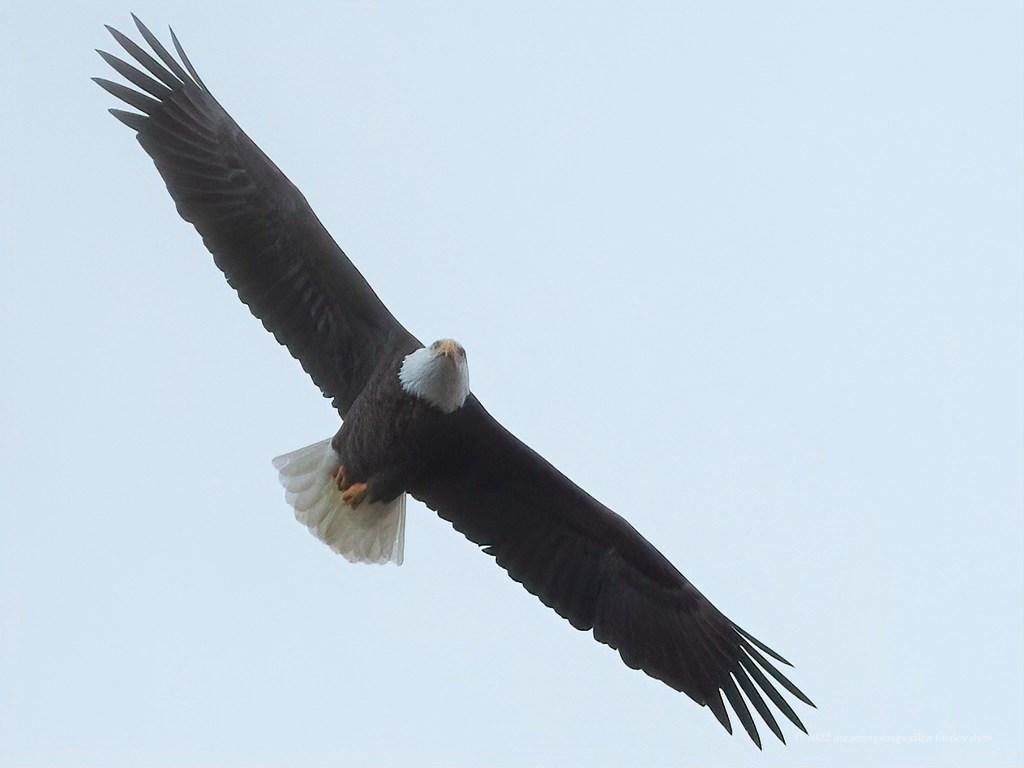
I began to realize as this past week went on, that there were no Nest Lining Materials that were trying to be brought to the nest by Mom Loblolly and Dad Pitch. This is critical because it was telling me that I needed to double check my possible egg laying dates. The nest lining materials are the last materials that go into the nest before Mom Loblolly lays her precious eggs. I was seeing lots of repair sticks trying to get to the nest (and often diverted by human intrusion) but no talons full of clutches of soft grasses. These grass materials, usually scooped from shorelines where the waves have stacked up these soft stems, are used to line the inside of the nest. This lining is then wallowed out and arranged by beak by Mom to make a protective nest bowl for the eggs and for the comfort of the incubating parent. So, over the last day or so, in consultation with the observations of others and their thoughts, the possible egg-laying date has been modified to February 1. Now, that gives us a little extra time to work on getting the gate closed so these parents are no longer harassed. It is always interesting when working with a new nest of only one prior breeding cycle because the parameters are just not really known until you have a couple of breeding seasons to use for data sources – that’s why field notes exist! So breathe a little tiny bit easier with me and let’s continue the CAMPAIGNING to get the gate CLOSED. There is now ADDITIONAL CONTACT information for you to use … it is available on the post for January 8 and the link to the same list with active hyperlinks is at my blog site https://docellensjourney.com/2022/01/08/help-big-pine-bald-eagle-nest-a-dozen-contacts/(opens in a new tab)! 1st photo is Mom Loblolly, 2nd photo is Dad Pitch this morning circling over their nest.
Jordan Lake: I want to share with you a chart that is used by the US Fish and Wildlife Service to help people understand how human impacts can effect breeding bald eagles. The Big Pine nest is currently going from Phase I to Phase II. Please take a moment and study this chart and then let your mind dwell on the fact that the gate to the shelter is open and allowing human disruption. The parents are trying to lay eggs at a point in the chart where the US FWS says that “human activity of even limited duration may cause nest desertion and abandonment of territory for the breeding season”. Please, continue to let your voices be heard daily. Call, email or visit those who are refusing to shut the gate. We want the Big Pine couple to succeed in having a family while we can work on the possibility of a web cam that we can all watch.
Big Pine Nest update: The gate is STILL OPEN. In the photo, that is Dad bald eagle once again trying to get a repair stick to his nest and once again having to bolt from the area. Yesterday morning there was a woman, holding a camera, standing inside the shelter building looking at the nest. She was INSIDE the single rope, single saw-horse “barrier” that is supposed to stop people from being exactly where she was. The fact that the woman was inside the “barrier” was through the utter failure of the inadequate planning of those tasked with protecting the bald eagles. Remember that this inadequate “barrier” was approved by the NC Division of State Parks, the Superintendent of the Jordan Lake State Recreation Area and the US Fish and Wildlife Service. The only way to protect Big Pine Nest is to CLOSE THE GATE to this area. Please, continue to spread the news about this problem. Please, every chance you get, contact every person who has the fate of the Big Pine Nest in their hands – contact list at the end of this post. BTW, the fact that the woman was inside the “barrier” was there is not a failure on the part of the Rangers at the park. The Rangers’ duties, first and foremost, and rightly so, are to take care of the human visitors to the park and that is a full-time task. My heart is so very grateful to all of you who are pitching in through every way each of you can. Thank you from the parent Bald Eagles of the Big Pine Nest. Who to Contact:



 doc ellen's journey