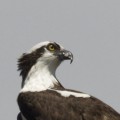
Jordan Lake, Tuesday, September 8, 2020. While out with Captain Doug, checking bald eagle and osprey nests, we found this very photogenic bald eagle. I caught him at that moment of suspension just between being perched and in full flight. It was great seeing a bald eagle up close again … it was great to find a bald eagle to share with all of you!!!!!
Jordan Lake, Haw River, Labor Day, September 7, 2020. To labor means to share. Each of us has a way to share our abilities … whether those abilities are of our bodies, or our minds or our hearts. I celebrate today those who labor and are sharing with each and every one of us. May the light of the Creator shine within all of our sharing and upon each and every one of us. Have a blessed day. Thank you for your labors!
Jordan Lake Dam, Haw River, Sunday, September 6, 2020. Doc Ellen‘s Natural Minute. It was delightfully cool this morning. The dry air felt like silk. I didn’t see many birds, only ones way far off. But that’s OK. Sometimes it’s great just to listen to the river. Take care, be safe, stay well!
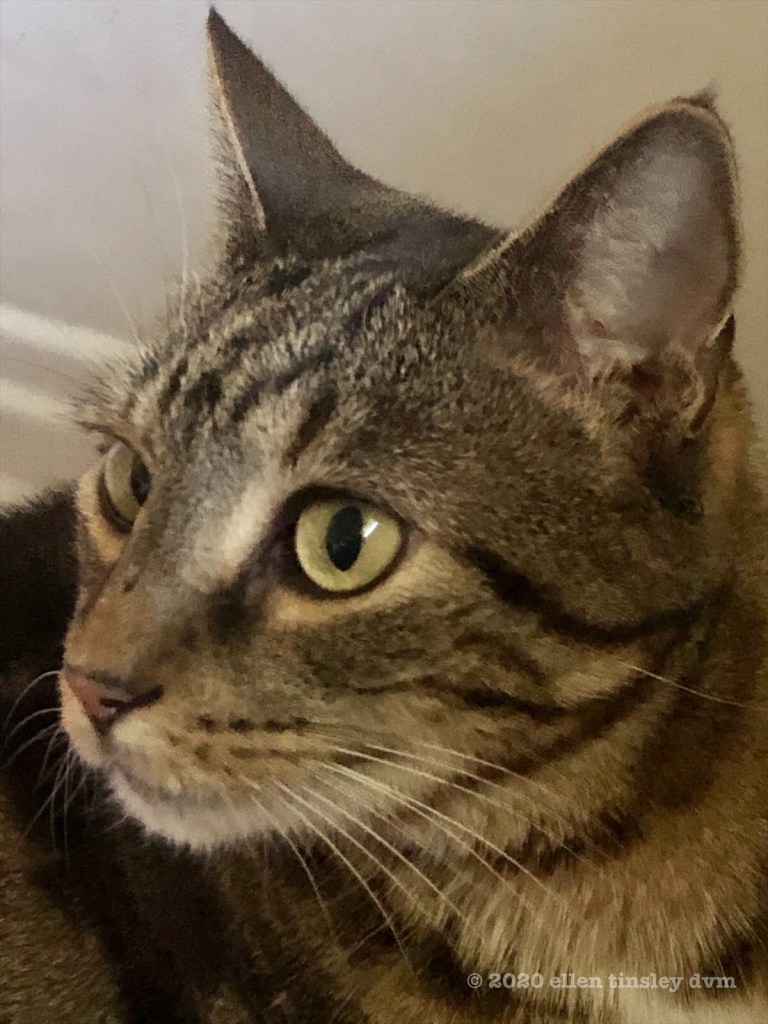
Nine years and a day ago, I found my companion Grayced the Cat. He was utterly starved, afraid and abandoned at Jordan Lake. Through the loving rehabilitation of his Auntie Alicia and what veterinary skills I could bring to his recovery, he thrived. He weighed less than a pound the day I found him as a probable five month old kitten. Today he weighs eight pounds and fills my lap and my life with grace. He just asked for dinner … he is, after all a cat …
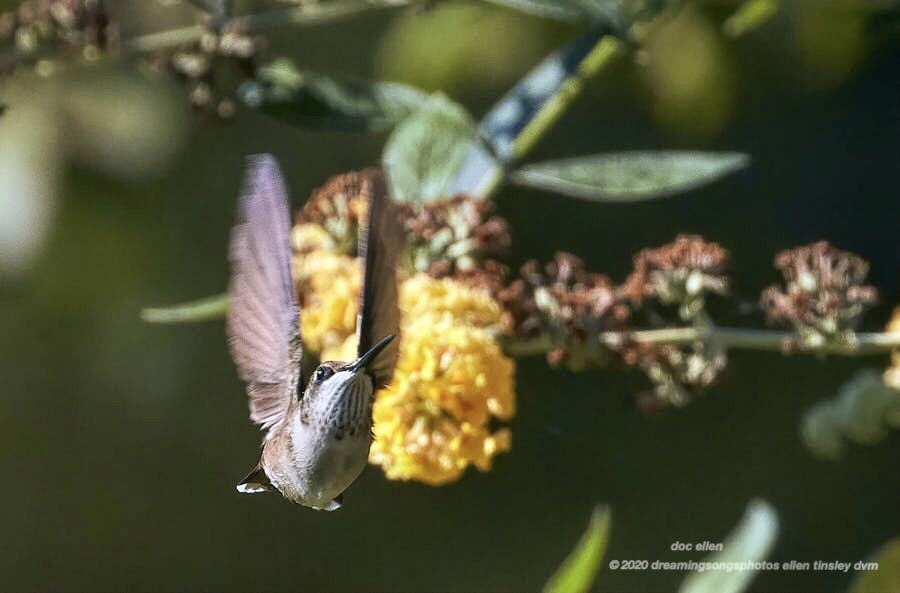
Jordan Lake Dam, Haw River, Friday, September 4, 2020. I have had bald eagles, ospreys and crows come by and give me a very close inspection. Well, this morning, the smallest bird in the whole area decided to try to inspect my lens. I don’t know who got more of an eyeful, me or the ruby-throated hummingbird!
Jordan Lake Dam, Haw River: We are all probably familiar with the soft coos of the mourning dove. Some of us know well the whistling sound of their wings when they take off and land. What some of us have not seen is just how differently the mourning dove lands when it does so on the ground. I have been photographing the landing sequence of the mourning dove for a number of years, trying to catch the moment that their feet touch the ground. The dove is extremely fast and erratic in take off, flight and landing. But, I was determined to show you the vertical, yes vertical, landing of the mourning dove. The bird comes in, pulling himself upright, lands on his tail feathers and drops immediately into a more horizontal position and then rapidly walks forward. It is neat! I have made the video loop twice and on the second pass, please note that the further away bird also landed vertically and rapidly walked forward. The back dove is blurred and this is how too often my photos turned out as I tried to catch that vertical moment of a dove’s landing.


 doc ellen's journey